Bat Houses

Wild Things Sanctuary is one of the only rehabilitation centers in upstate New York to rehabilitate bats. We love them! Many people have asked us about bat houses. Bat houses have become especially important in recent years as many roosting places in caves have become infected with White Nose Syndrome. Bats who commonly use bat houses in the NE are the Big brown bat (Eptesicus fuscus) (like the female bat pictured above) and the Little brown bat (Myotis lucifugus). Give the bats a home and have the benefit of having free mosquito control!
We are not experts on bat houses, but we put together this page to help others find out information that they need in buying, building and/or setting up a bat house. Plus we've included information on how to attract bats. All of the below has come from other sources, which are noted. Wild Things has found that Bat Conservation International probably has the most comprehensive website with everything from how to build your own bat house, to where and how to install houses to make them extra attractive to bats looking for real estate. Check out Bat Conservation International's bat house webpage. Below are a few quick highlights:
We are not experts on bat houses, but we put together this page to help others find out information that they need in buying, building and/or setting up a bat house. Plus we've included information on how to attract bats. All of the below has come from other sources, which are noted. Wild Things has found that Bat Conservation International probably has the most comprehensive website with everything from how to build your own bat house, to where and how to install houses to make them extra attractive to bats looking for real estate. Check out Bat Conservation International's bat house webpage. Below are a few quick highlights:
All you need to know about attracting bats:
| |||||
| attracting_bats.pdf |
Lots of great info on Bat Houses:
Did you know that in different geographic temperature zones bat houses should be different colors to either warm them up or keep them cool?
Again, from Bat Conservation International
Again, from Bat Conservation International

| bat_house_criteria.pdf |
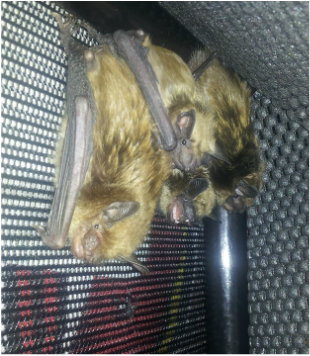
A mother Big Brown Bat, her twin baby boys (to the right), and adopted female baby (on her back) find a safe place at Wild Things Sanctuary.
Where to place your bat house in the NE United States:
Bat houses in the Northeast United States should be:
|
The placement of your bat house plays a major role in the internal temperature. Houses can be attached to structures such as poles, sides of buildings and tall trees without obstructions. The area under and in front of the bat house should be clear, allowing the bats to fly in and out. There should be at least 20 feet of open space around the bat house. Houses placed on poles and structures tend to become occupied quicker than houses placed on trees. Your bat house should be mounted at least 15 feet above the ground, the higher the house the greater the chance of attracting bats.
Bat houses should face south to southeast to take advantage of the morning sun. In northern states and Canada, bat houses need to receive at least 6 to 8 hours of direct sunlight. It is also advantageous to paint the house black to absorb plenty of heat. Baby bats require a very warm temperature. Paint only the outside of your bat house and use a non-toxic, latex paint.
Bats return from migration and awaken from hibernation as early as March in most of the U.S. They will be abundant through out the summer and into early fall. Approximately half of all bat houses are occupied within the first summer and up to 80% are occupied within the first 2-3 years. If bats do not roost in your house by the end of the third summer, move the house to a different location. It is also helpful to attach more than one bat house in your yard in order to provide bats with different housing options and increase your chances of having an occupied bat house.
Bat houses should face south to southeast to take advantage of the morning sun. In northern states and Canada, bat houses need to receive at least 6 to 8 hours of direct sunlight. It is also advantageous to paint the house black to absorb plenty of heat. Baby bats require a very warm temperature. Paint only the outside of your bat house and use a non-toxic, latex paint.
Bats return from migration and awaken from hibernation as early as March in most of the U.S. They will be abundant through out the summer and into early fall. Approximately half of all bat houses are occupied within the first summer and up to 80% are occupied within the first 2-3 years. If bats do not roost in your house by the end of the third summer, move the house to a different location. It is also helpful to attach more than one bat house in your yard in order to provide bats with different housing options and increase your chances of having an occupied bat house.
Where to buy a bat house:
Info & Video on how to build a bat house & bat "pup catcher":
|

A baby bat climbing back inside her bat house to find her mother after falling into the "pup catcher". From Bat World Sanctuary.
| ||||
More on bats! Bat ID'ing and successful bat house stories
- Tuttle, Merlin D., Hensley, Donna (1993). "Bat Houses: The Secrets of Success." Bats 11 (1).
- For more information on identifying bats check out "Stokes Beginners Guide to Bat Identification."
- Check out our website Bats911 for more information